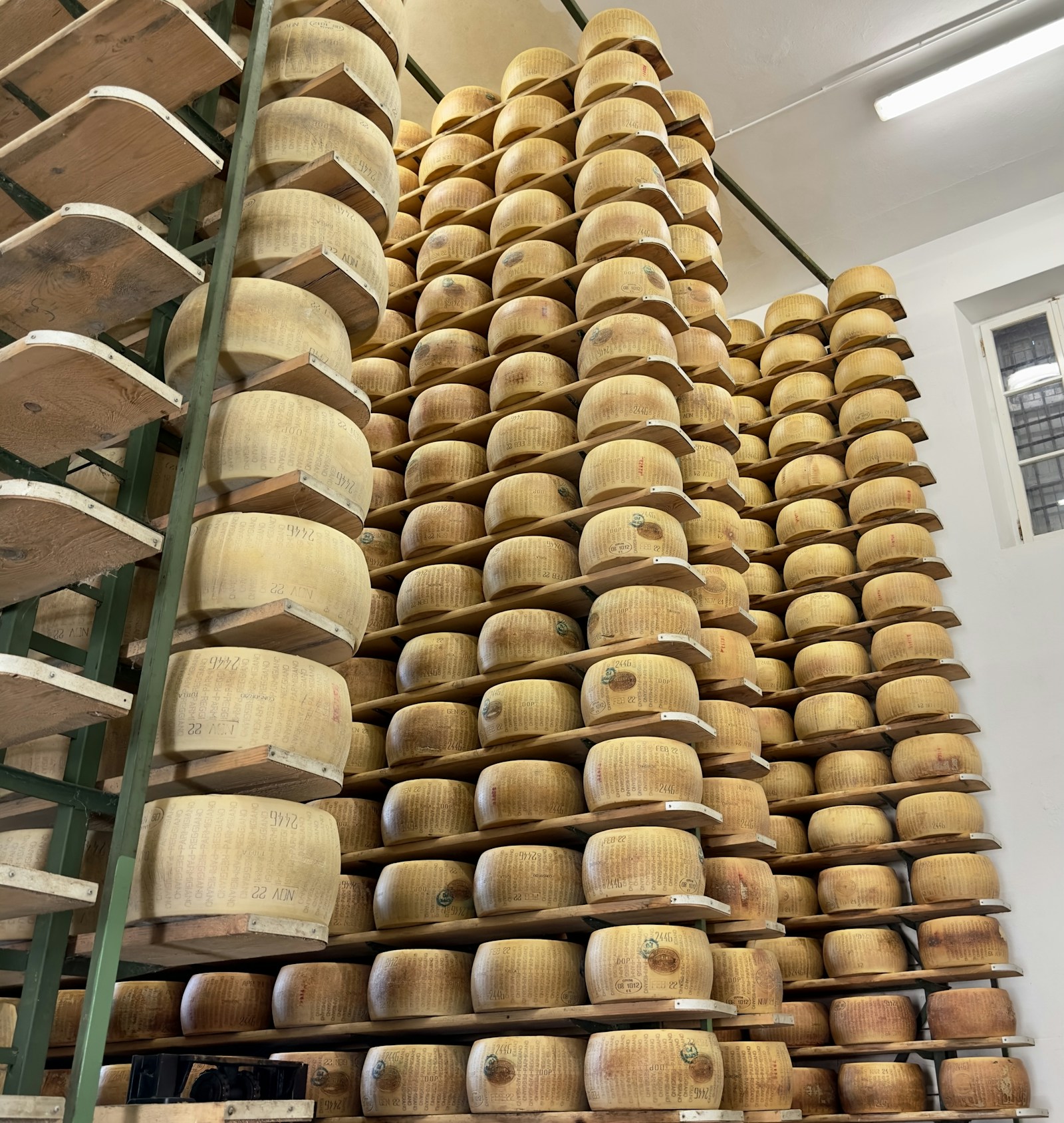
Inside the brick warehouse at Montecavolo, the air carries a heavy scent of dry pine shelves and aging milk. Long wooden racks rise ten meters toward the ceiling, holding hundreds of pale yellow wheels that rest under steady electric lights. This building belongs to Credito Emiliano, an Italian bank that has stored agricultural wealth since 1953. Gold bars and paper currency fill ordinary bank vaults, but this branch in the province of Reggio Emilia accepts cheese as security for cash loans.
Two years of waiting in the Po valley
Making Parmigiano-Reggiano requires patience and strict regional rules that date back several centuries. Back then, dairy farmers around Parma and Reggio Emilia turned daily cow milk into large wheels that needed months to dry. Today, producers must still wait between twelve and thirty-six months before their cheese can reach market shelves. This long aging period creates a serious financial problem for family farms, because cows require daily feed and workers need regular wages while the inventory sits untouched on wooden planks.
In 1953, the directors of Credito Emiliano created a loan system that addressed this exact delay. A local farmer delivers fresh wheels to the bank warehouse shortly after production, and the bank provides an immediate cash loan worth roughly seventy percent of the estimated final value. The cheese acts as collateral, which means the bank holds the physical goods until the borrower repays the debt. If the producer repays the money after two years, the wheels return to the farm for retail distribution. If the producer defaults on the loan, the bank sells the matured wheels at public auction to recover its funds.
A small hammer against forty kilograms of milk
Because the value of the loan depends entirely on food quality, the bank treats storage with extreme care. The warehouse at Montecavolo maintains a constant temperature of eighteen degrees Celsius and eighty-five percent humidity. Specialized machines travel along the aisles to wipe and turn every forty-kilogram wheel twice a month, preventing mold from settling into the rind. Today, the vaults hold more than three hundred thousand wheels, representing over one hundred million euros in agricultural credit.
At the twelfth month, an inspector from the local cheese consortium visits the warehouse carrying a small silver-plated hammer. The inspector strikes each wheel across its surface and listens to the rebound sound. A clear musical ring proves that the interior texture remains solid and uniform, while a dull thud warns of hidden cracks or air pockets. Wheels that pass the hearing test receive an official oval mark burned directly into the hard rind with a heated bronze iron. Those that fail lose their designation and get sold as secondary table cheese.
Once the bronze mark is stamped into the crust, the wheel enters the bank ledger as verified security. The cheese rests on its pine plank for another year, growing harder in the still air while the loan on the farmer’s account slowly matures.
Leave a Reply