Blog

  • Extreme Heat May Make People Age Faster

    Extreme Heat May Make People Age Faster

    We know that very hot weather can feel uncomfortable, exhausting, and even dangerous. But new research shows that extreme heat may also speed up the aging process. Scientists say that spending too much time in high temperatures could increase the risk of diseases and other health problems linked to aging.

    Researchers at the University of Southern California studied how heat affects aging. They used a method called epigenetic clocks, which measures chemical changes in DNA that are connected to aging. The team looked at blood samples from 3,600 older adults across the United States.

    The results showed that for every 200 days of temperatures above 32.2°C over six years, people’s biological age increased by up to 3.5 months. This means that people living in very hot areas may age faster at the cellular level compared to those in cooler places.

    Our bodies react to heat in different ways. Heat can cause dehydration, inflammation, and stress on cells. All of these can damage DNA and speed up epigenetic aging, which controls how our genes work as we get older.

    The study suggests that extreme heat may change how DNA functions, making the body biologically older than its real age. However, not everyone is affected in the same way. Factors such as air conditioning, outdoor activities, and lifestyle choices may change the risk.

    The researchers considered other factors like age, race, income, smoking, drinking, and obesity. But they did not study personal habits like how often people use cooling methods. The research focused on older adults, but scientists think younger people could also be affected. More studies are needed to understand how heat might influence all age groups.


  • Australian Sunscreens Failing to Deliver Promised Protection, Study Reveals

    Australian Sunscreens Failing to Deliver Promised Protection, Study Reveals

    A number of Australia’s most trusted sunscreen brands, including Bondi Sands, Banana Boat, and even the Cancer Council, have been found to offer significantly less protection than advertised, according to a new investigation by consumer advocacy group Choice.

    The organisation commissioned an accredited laboratory to test 20 widely available sunscreens marketed as SPF 50 or 50+. The results were striking: 16 failed to meet their stated SPF ratings, raising questions about product reliability, consumer safety, and regulatory oversight.

    Questioning SPF Claims

    SPF, or sun protection factor, indicates how effectively a sunscreen prevents sunburn by filtering ultraviolet B (UVB) radiation. An SPF 30 product is expected to block 96.7% of UVB rays, while SPF 50 should block around 98%. These claims fall under the jurisdiction of the Therapeutic Goods Administration (TGA), which enforces compliance through standardised testing.

    Choice’s most concerning finding came from Ultra Violette’s Lean Screen SPF 50+, which returned an SPF rating of just four in its first test, and five in a second, independently verified trial in Germany. Chief executive Ashley de Silva described the outcome as “shocking.” Ultra Violette, however, rejected the results as “misleading,” claiming its own tests—conducted on a full 10-person panel in line with TGA protocols—produced an SPF of 61.7.

    Brands Under Scrutiny

    The investigation found other major brands also fell short. Products from Coles, Nivea, Sun Bum, Banana Boat, Bondi Sands, Cancer Council, Neutrogena, Aldi, Woolworths, and Invisible Zinc tested well below their advertised SPF 50+ claims, in some cases scoring as low as the mid-20s.

    Only four sunscreens exceeded their claims: La Roche-Posay Anthelios Wet Skin SPF 50+ (72), Neutrogena Ultra Sheer Body Lotion SPF 50 (56), Cancer Council Kids Sunscreen 50+ (52), and Mecca Cosmetica To Save Body SPF 50+ (51).

    Industry and Regulatory Response

    While de Silva noted that sunscreens testing in the 30s still provide “a very good level of protection,” he stressed the importance of truthful labelling: “Consumers are entitled to confidence that the product they buy performs as promised.”

    Several companies, including Cancer Council and Aldi, have insisted their sunscreens comply with TGA standards and have submitted products for further testing. Bondi Sands and Ultra Violette dismissed Choice’s results as unrepresentative.

    The TGA has confirmed it is reviewing the findings and will “take regulatory action as required.” Meanwhile, the Australian Competition and Consumer Commission (ACCC) said it is working with the TGA to determine whether any companies have breached consumer law by making false or misleading claims.

    Trust in Question

    For a country with some of the highest skin cancer rates in the world, sunscreen efficacy is not a trivial matter. The findings highlight the gap between marketing promises and independent performance testing—raising concerns over whether consumers can trust that SPF labels are more than just numbers on a bottle.

  • Italy Bids Farewell to Fashion Icon Giorgio Armani

    Italy Bids Farewell to Fashion Icon Giorgio Armani

    Giorgio Armani, the legendary Italian designer who revolutionized modern tailoring and became synonymous with understated elegance, has passed away at the age of 91. Although his name has long been associated with global glamour — from Hollywood red carpets to Milan’s runways — his final farewell will unfold in a markedly private setting, far from the limelight.

    Born in 1934 in the northern Italian town of Piacenza, Armani will be laid to rest in Rivalta, a nearby village where his family roots run deep. His funeral, to be held at the San Martino church, will host around 20 guests in a ceremony deliberately shielded from the public eye. Local businesses recalled his enduring connection to the area: one restaurant owner reminisced that Armani often praised their tortelli, which reminded him of his mother’s cooking. As a sign of mourning, Rivalta will close to visitors, and Armani boutiques across Italy will shutter for the afternoon.

    This quiet service contrasts sharply with the public tributes of the preceding weekend. Approximately 16,000 people visited Armani’s funeral chamber at Milan’s Armani Teatro, where his body lay in state among 300 lanterns. Citizens, dignitaries, and fellow designers, including Donatella Versace, Milan’s mayor Giuseppe Sala, and filmmakers Gabriele Salvatores and Giuseppe Tornatore, gathered to honor a man widely seen as a cultural ambassador for Italy.

    The designer’s absence from his June 2025 runway show — the first in his career — sparked speculation about his health, though his company said only that he was “recovering at home.” Until his final days, Armani remained deeply involved in preparations for a 50th-anniversary retrospective and runway event, both of which are expected to proceed in tribute to his enduring legacy.

    Officials in both Piacenza and Milan have declared a day of mourning, underscoring Armani’s profound influence on Italian identity. Parish priest Giuseppe Busani, who will officiate the ceremony, reflected on the family’s long relationship with Rivalta: “We are grateful he chose this place; many Armani family events have been celebrated here.” According to local reports, the designer will be interred in the family chapel alongside his parents and his brother Sergio, who died in 1985.

    A visionary who redefined elegance for nearly half a century, Armani leaves behind not only a global empire but also a cultural imprint that transcends fashion.

  • NASA Rover Finds Possible Evidence of Life on Mars

    NASA Rover Finds Possible Evidence of Life on Mars

    Scientists have found unusual rocks on Mars that may show signs of past life. The rocks, discovered by NASA’s Perseverance Rover, are covered with small spots called “leopard spots” and “poppy seeds.” They are a type of mudstone, about 3.5 billion years old, found in an ancient riverbed.

    Experts think the spots contain minerals that could have been made by tiny living things (microbes) long ago. Another possibility is that the minerals were created by natural geological processes. Still, NASA says these rocks may be the strongest evidence of life ever found on Mars.

    “This is very exciting,” said Professor Sanjeev Gupta from Imperial College London. “If we saw these features on Earth, we might say they were made by microbes. We cannot say for sure that this is life, but it gives us something important to study.”

    NASA scientist Dr. Nicola Fox added: “It’s like finding a fossil. Maybe it’s something microbes left behind.”

    To know for sure, the rocks need to be brought back to Earth. Perseverance has already collected samples and stored them in containers. NASA and the European Space Agency (ESA) planned a mission to return them, but budget cuts in the U.S. may cancel the project. China is also planning a Mars sample return mission, possibly in 2028.

    Mars today is a cold, dry desert. But billions of years ago, it had a thicker atmosphere and water. That’s why the Jezero Crater, where Perseverance landed in 2021, is a good place to search for past life. The rover has spent four years exploring this area, which was once a lake with a river.

    The rover studied the rocks with its onboard instruments and sent the data to Earth. Scientists think the minerals formed when mud at the bottom of the lake reacted with organic matter. On Earth, such reactions are usually connected to microbes.

    However, some scientists say the reactions could also happen without life, but this would require very high temperatures. The rocks, though, do not show signs of heating.

    “This could be the best evidence for life on Mars we have so far,” said Dr. Joel Hurowitz, one of the study’s authors. “But to be confident, we need to study the samples here on Earth.”

  • 102-Year-Old Man Becomes the Oldest Person to Climb Mount Fuji

    102-Year-Old Man Becomes the Oldest Person to Climb Mount Fuji

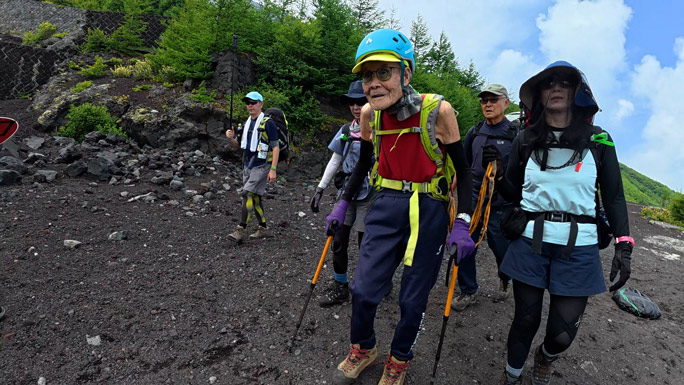
    A Japanese man, Kokichi Akuzawa, has become the oldest person to climb Mount Fuji at the age of 102. With help from his daughter and friends, he reached the top of Japan’s tallest mountain, which is 3,776 meters high.

    Akuzawa is an experienced climber. He is the honorary chairman of the Gunma Mountaineering Club and has climbed mountains almost every week. For his 99th birthday in 2022, he climbed Mount Nabewariyama, a smaller peak near Tokyo. He had already climbed Mount Fuji once before at age 96. Since then, he has faced serious health problems, such as a fall, heart failure, and shingles. Still, he wanted to climb Mount Fuji one last time.

    On August 3, Akuzawa started climbing the Yoshida trail, the easiest and most popular of Fuji’s four routes. Normally, this trail takes about six hours, but Akuzawa took three days, resting in huts along the way. “It was tough, and it felt very different from the last time I climbed,” he said. “I’m amazed I made it to the top.”

    Before the climb, Akuzawa trained by walking one hour every morning and climbing other mountains. The weather was good, but near the summit it became very cold with less oxygen. On the third day, he wanted to stop, but his daughter Motoe, who is 70, encouraged him to continue step by step. Finally, on August 5 at 11 a.m., Akuzawa reached the summit.

    “I couldn’t have done it without everyone’s help. I’m happy now,” he said.

    Mount Fuji, located southwest of Tokyo, is a sacred symbol of Japan and has appeared in many famous artworks, including Hokusai’s Thirty-Six Views of Mount Fuji. Over the years, several people have held the record as the oldest climber of Fuji. In 1986, Teiichi Igarashi summited at age 99. In 1994, Ichijiro Araya reached the top at 100 years and 258 days. Now, Akuzawa holds the record at 102 years and 51 days.

    Guinness World Records gave him an official certificate. When asked if he would climb again, Akuzawa replied, “For now, I am satisfied. If you ask me next year, maybe I’ll give you a different answer.”

  • Chapter 3

    An hour and forty minutes later, Hartley stepped off the train at Floralhurst. He walked quickly to his beautiful two-story cottage with its wide lawn.

    A woman with long black hair and a white summer dress came running to meet him. She hugged him tightly.

    When they entered the hall, she said:
    “Mamma is here. The car will come for her in half an hour. She came to dinner—but there’s no dinner.”

    “I must tell you something,” Hartley said seriously. “I wanted to say it gently, but since your mother is here, we may as well say it now.”

    He bent down and whispered in her ear.

    His wife screamed. Her mother ran into the hall. Then his wife screamed again—but this time with joy.

    “Oh, mamma!” she cried happily. “What do you think? Vivienne is coming to cook for us! She is the same girl who worked for the Montgomerys for a whole year. And now, Billy dear,” she added sweetly, “you must go right down to the kitchen and send Hloise away. She has been drunk all day again.”

  • Chapter 2

    Hartley rang the “McComus” bell. The door opened slowly, as if it wasn’t sure whether to trust him. He climbed the stairs. On the fourth floor he found Vivienne standing in the doorway. She smiled brightly and invited him inside.

    Vivienne was twenty-one. She had golden-red hair, blue eyes, and a clear white face. She looked both strong and graceful. Her simple clothes made her appear like both a country girl and a lady.

    “Vivienne,” said Hartley, “you didn’t answer my letter. I searched for a week to find you. Why did you keep me waiting?”

    The girl looked out the window.
    “Mr. Hartley, I don’t know what to say. I know life with you would have many advantages. Sometimes I think I would be happy. But other times, I am not sure. I am a city girl, and I am afraid of a quiet life in the suburbs.”

    “My dear,” Hartley said with passion, “you will have everything you want. We can go to the city for theatres, shopping, and visits whenever you like. You can trust me.”

    “Yes,” she said with a smile. “I know you are kind. Any girl will be lucky to marry you.”

    Hartley’s heart filled with hope.
    “Promise me, Vivienne. Come with me. You will never regret it.”

    Vivienne sighed and looked at her hands. Hartley suddenly became suspicious.
    “Tell me,” he asked, “is there someone else?”

    Her face turned red.
    “Yes, there is another man. But I have promised him nothing.”

    “His name?” asked Hartley sharply.

    “Townsend.”

    Hartley’s jaw tightened.
    “Rafford Townsend! After all I’ve done for him!”

    Vivienne leaned out the window.
    “His car has stopped below. He is coming now for my answer. Oh, I don’t know what to do!”

    The doorbell rang. Hartley said firmly:
    “Stay here. I will meet him.”

    Townsend came up the stairs quickly. He stopped when he saw Hartley.

    “Go back,” said Hartley, pointing to the stairs.

    Townsend tried to smile. “What’s the problem, old friend?”

    “Go back,” repeated Hartley. “The kill is mine.”

    Townsend pretended he had come to see a plumber, but finally he left, angry.

    Hartley returned to Vivienne.
    “I must have you,” he said. “No more delays.”

    “When do you want me?” she asked.

    “Now. As soon as you are ready.”

    She looked at him seriously.
    “Do you think I would come while Hloise is still in your house?”

    Hartley felt shocked.
    “She shall go,” he said. “I will send her away tonight.”

    “Then,” said Vivienne, “my answer is yes.”

  • Chapter 1

    On the glass door of Room 962 were the words: “Robbins & Hartley, Brokers.”
    It was after five o’clock. The clerks had already gone home. Cleaning women walked through the tall office building. Hot air came through the open windows, mixed with city smells.

    Robbins was about fifty. He liked theatre shows and hotel bars. He joked with his young partner.

    “Tonight will be very hot,” Robbins said. “You people who live outside the city will be lucky. You will have fresh air, insects singing, and cold drinks on the porch.”

    Hartley, twenty-nine, serious and nervous, only sighed.
    “Yes,” he said, “it is always cooler in Floralhurst at night.”

    At that moment a man entered. He looked mysterious. He walked straight to Hartley.
    “I found her address,” the man whispered dramatically.

    Hartley frowned at him to be quiet. Robbins, meanwhile, put on his hat and cane and left for his evening entertainment.

    “Here is the address,” the man said normally now, giving Hartley a piece of paper. It said:

    “Vivienne Arlington, No. 341 East – Street, care of Mrs. McComus.”

    “She moved there last week,” said the man. “Do you want me to follow her? I can do a fine job—only $7 a day plus expenses.”

    “No, that’s not necessary,” Hartley interrupted. “I only wanted the address. How much do I owe you?”

    “Ten dollars,” said the detective.

    Hartley paid him and left the office. He took a Broadway streetcar, then another car that brought him to an old part of town. After walking a few blocks, he arrived at a new apartment house called The Vallambrosa. Its balconies and fire escapes were full of laundry, children, and even plants trying to survive the summer heat

  • Alice in Wonderland

    Alice in Wonderland

    “Alice’s Adventures in Wonderland” by Lewis Carroll is a classic children’s novel written in the mid-19th century. The story follows a young girl named Alice who, feeling bored and sleepy while sitting by a riverbank, encounters a White Rabbit and follows it down a rabbit hole, plunging into a fantastical world filled with curious creatures and whimsical adventures. The opening of the book introduces Alice as she daydreams about her surroundings before spotting the White Rabbit, who is both flustered and animated. Curious, Alice pursues the Rabbit and finds herself tumbling down a deep rabbit hole, leading to a curious hall filled with doors, all locked. After experiencing a series of bizarre changes in size from eating and drinking mysterious substances, she begins exploring this new world, initially frustrated by her newfound challenges as she navigates her size and the peculiar inhabitants she meets. The narrative sets the tone for Alice’s whimsical and often nonsensical adventures that characterize the entire tale.

  • Girl

    Girl

    Hartley and Robbins meet one another in a building so near to the railroad that the smell of coal unceasingly wafts in through the open windows. A detective enters the room where they are chatting and tells Hartley that he has found ‘the address’ of the girl. Who is this girl and why is she so special that Hartley promises her everything to persuade her to go with him? O. Henry gives us the answer to the mystery in an explosive surprise, even by his own standards.