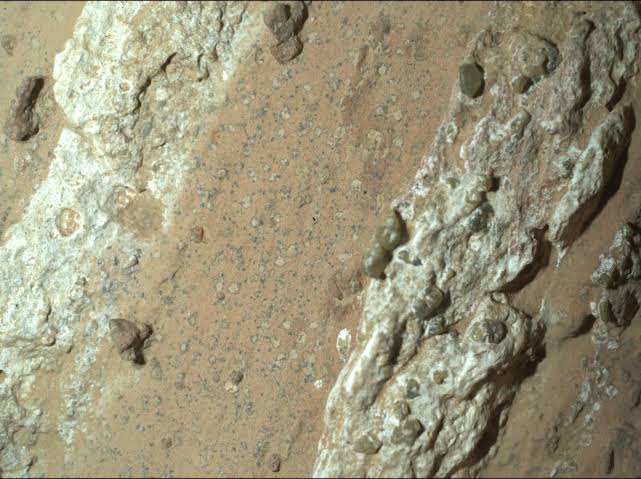
Scientists have found unusual rocks on Mars that may show signs of past life. The rocks, discovered by NASA’s Perseverance Rover, are covered with small spots called “leopard spots” and “poppy seeds.” They are a type of mudstone, about 3.5 billion years old, found in an ancient riverbed.
Experts think the spots contain minerals that could have been made by tiny living things (microbes) long ago. Another possibility is that the minerals were created by natural geological processes. Still, NASA says these rocks may be the strongest evidence of life ever found on Mars.
“This is very exciting,” said Professor Sanjeev Gupta from Imperial College London. “If we saw these features on Earth, we might say they were made by microbes. We cannot say for sure that this is life, but it gives us something important to study.”
NASA scientist Dr. Nicola Fox added: “It’s like finding a fossil. Maybe it’s something microbes left behind.”
To know for sure, the rocks need to be brought back to Earth. Perseverance has already collected samples and stored them in containers. NASA and the European Space Agency (ESA) planned a mission to return them, but budget cuts in the U.S. may cancel the project. China is also planning a Mars sample return mission, possibly in 2028.
Mars today is a cold, dry desert. But billions of years ago, it had a thicker atmosphere and water. That’s why the Jezero Crater, where Perseverance landed in 2021, is a good place to search for past life. The rover has spent four years exploring this area, which was once a lake with a river.
The rover studied the rocks with its onboard instruments and sent the data to Earth. Scientists think the minerals formed when mud at the bottom of the lake reacted with organic matter. On Earth, such reactions are usually connected to microbes.
However, some scientists say the reactions could also happen without life, but this would require very high temperatures. The rocks, though, do not show signs of heating.
“This could be the best evidence for life on Mars we have so far,” said Dr. Joel Hurowitz, one of the study’s authors. “But to be confident, we need to study the samples here on Earth.”
Leave a Reply